If you want more likes, comments, shares, and reach on social media, choosing the right hashtags is essential. The best engagement hashtags are not always the most popular ones—they are the hashtags your target audience actively follows and interacts with. In this guide, you’ll learn how to find hashtags for engagement using platform insights, competitor research, hashtag analytics tools, and proven strategies used by social media marketers.

If you’re posting consistently on social media but your engagement isn’t growing, your hashtag strategy may be the missing piece.
Many creators and brands assume that using the most popular hashtags automatically leads to more likes, comments, shares, and followers. In reality, the best hashtags for engagement aren’t necessarily the biggest ones. They’re the hashtags your target audience actively follows, searches, and interacts with.
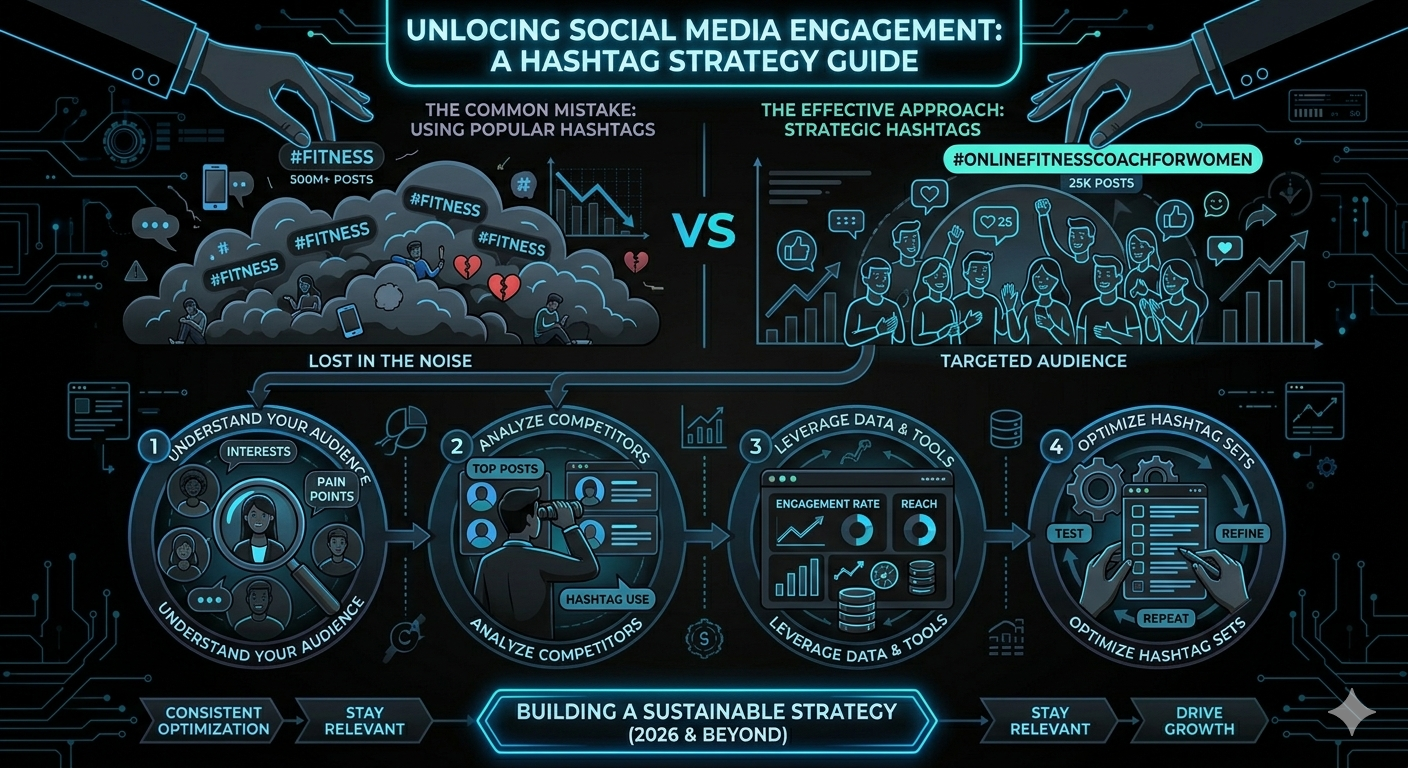
A fitness coach using #fitness may compete against hundreds of millions of posts. Another coach using #onlinefitnesscoachforwomen may reach a smaller but highly targeted audience that’s much more likely to engage.
That’s why finding the right hashtags is no longer about copying trending lists from the internet. It’s about understanding your audience, analyzing competitors, leveraging data, and continuously optimizing your hashtag sets.
In this guide, you’ll learn exactly how to find hashtags for engagement, which tools to use, how top creators discover new hashtags, and how to build a sustainable hashtag strategy that continues working in 2026 and beyond.
Quick Answer: How Do You Find Hashtags for Engagement?
To find hashtags that drive engagement:
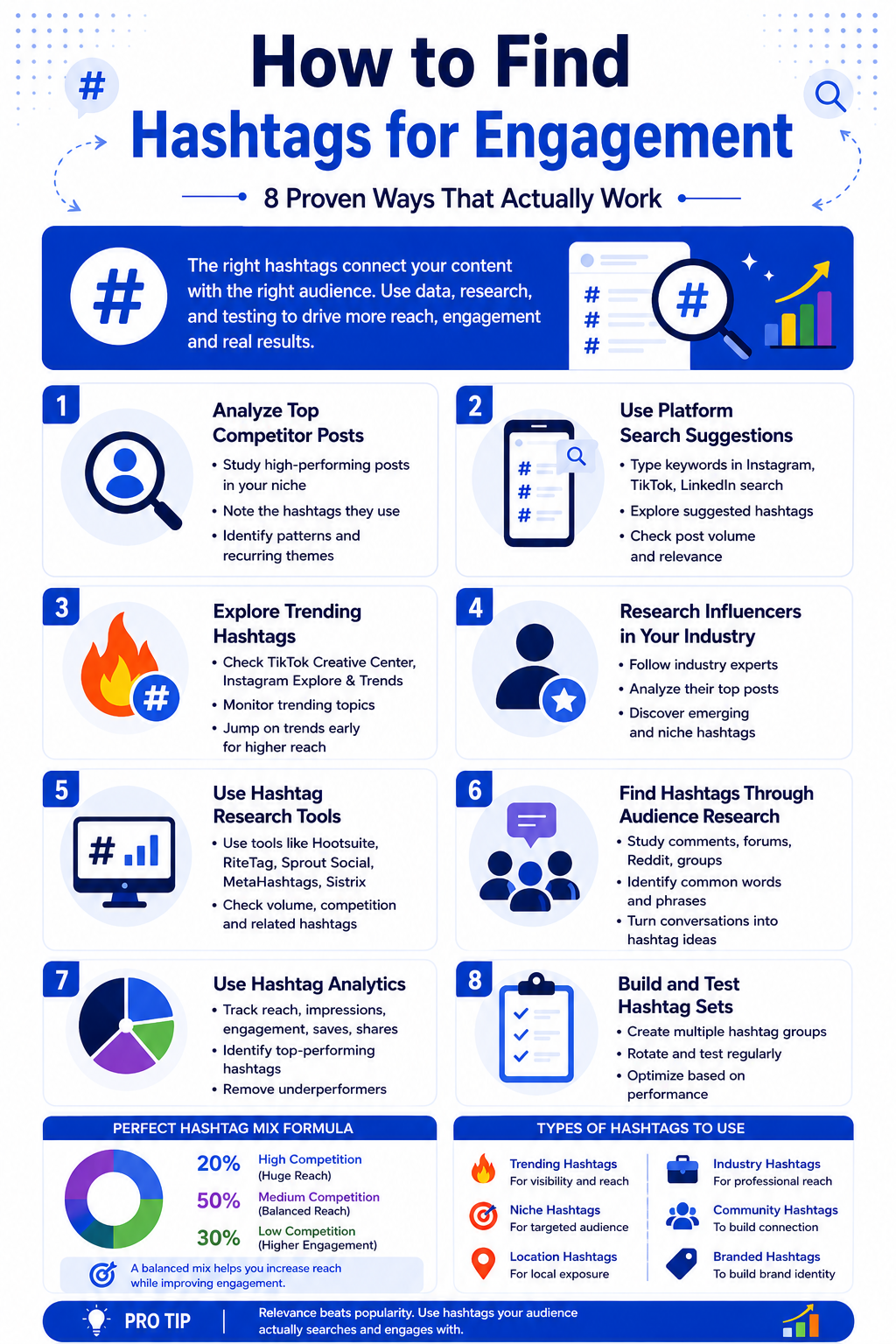
- Research top-performing competitors in your niche.
- Analyze hashtags used in viral and high-engagement posts.
- Use Instagram, TikTok, and LinkedIn search suggestions.
- Explore trending hashtags through hashtag research tools.
- Create a mix of broad, niche, branded, and community hashtags.
- Track engagement metrics for every hashtag group.
- Replace low-performing hashtags with new variations regularly.
The most effective strategy combines research, testing, and optimization rather than relying on random trending hashtags.
Why Hashtags Still Matter in 2026
Every few years, marketers claim hashtags are dead.
Yet hashtags continue to play a significant role across platforms like Instagram, TikTok, LinkedIn, YouTube Shorts, and X (formerly Twitter).
While algorithms have become smarter, hashtags still provide valuable contextual signals that help platforms understand content and connect it with interested audiences.
How Social Platforms Use Hashtags
Social media algorithms analyze multiple signals, including:
- Keywords in captions
- User behavior
- Content topics
- Engagement patterns
- Hashtags
Hashtags act as categorization signals.
For example:
A post tagged with:
#digitalmarketing
#seo
#contentmarketing
Immediately gives platforms additional context about the content topic.
This improves discoverability and helps platforms show the content to users interested in those subjects.
Hashtags vs Keywords: What’s the Difference?
Many marketers confuse hashtags with keywords.
Keywords help search engines understand content.
Hashtags help social platforms categorize content and improve discovery.
Modern algorithms often use both.
For example, Instagram now analyzes:
- Caption text
- Image recognition
- Video content
- Audio
- Hashtags
Together.
This means hashtags alone won’t make content go viral, but they still contribute to overall discoverability.
Do Hashtags Still Increase Engagement?
Yes—when used strategically.
Hashtags can:
- Increase reach
- Improve discoverability
- Help users find your content
- Connect you with niche communities
- Generate additional profile visits
- Improve saves and shares
The key is relevance.
A smaller, highly targeted hashtag often generates more engagement than a massive generic hashtag.
What Makes a Good Engagement Hashtag?
Not every hashtag deserves a place in your content.
The best engagement hashtags share several characteristics.
Relevance
The hashtag must accurately represent the content.
Using irrelevant trending hashtags may increase impressions temporarily, but it usually decreases engagement rates.
Users won’t engage with content that doesn’t match their expectations.
Audience Intent
Think about who searches the hashtag.
Ask:
- What are they looking for?
- What problems are they trying to solve?
- What content do they usually engage with?
The closer your content aligns with audience intent, the higher your engagement potential.
Search Volume vs Competition
High-volume hashtags attract more impressions but also more competition.
For example:
#marketing
Millions of posts
#saasmarketing
Far fewer posts
Although #marketing reaches a larger audience, #saasmarketing often delivers better engagement because it’s more targeted.
Niche Hashtags
Niche hashtags generally outperform broad hashtags for engagement.
Examples:
Instead of:
#fitness
Use:
#strengthtrainingforwomen
Instead of:
#marketing
Use:
#b2bcontentmarketing
Specific hashtags attract qualified audiences.
Branded Hashtags
Branded hashtags help build community and user-generated content.
Examples:
#ShareACoke
#JustDoIt
Brands can encourage followers to use branded hashtags to increase engagement and content participation.
Community Hashtags
Community hashtags connect users with common interests.
Examples:
#WomenInTech
#Bookstagram
#TravelCreators
These hashtags often generate highly engaged audiences because users actively participate in those communities.
8 Proven Ways to Find Hashtags for Engagement
Finding high-performing hashtags isn’t luck.
It’s a repeatable process.
1. Analyze Top-Performing Competitor Posts
Your competitors have already done some of the research.
Start by identifying:
- Industry leaders
- Influencers
- Competitors
- Niche creators
Review their highest-performing posts.
Look for:
- Frequently used hashtags
- Engagement levels
- Content themes
- Audience reactions
Create a spreadsheet and track recurring hashtags.
Patterns quickly emerge.
Often, you’ll discover niche hashtags you never would have found through traditional research.
2. Use Instagram Search Suggestions
Instagram remains one of the most powerful hashtag discovery tools.
Simply type a keyword into Instagram’s search bar.
For example:
“SEO”
Instagram will suggest:
- #seo
- #seotips
- #seomarketing
- #seoexpert
- #seostrategy
Each hashtag also displays approximate post volume.
This helps evaluate popularity and competition.
Pro Tip:
Don’t stop at the first level.
Click related hashtags and continue exploring deeper opportunities.
This method often reveals highly relevant long-tail hashtags.
3. Explore Trending Hashtags on TikTok
TikTok trends move faster than any other platform.
Use:
- TikTok Search
- Creative Center
- Discover Page
- Trending Sounds
Monitor:
- Trending topics
- Trending keywords
- Viral creators
Hashtags frequently emerge from broader content trends.
Being early often produces exceptional engagement.
4. Research Influencers in Your Industry
Influencers are often the first to identify emerging hashtags before they become mainstream.
This makes influencer research one of the most effective ways to uncover engagement opportunities.
Look at:
- Industry experts
- Micro-influencers
- Content creators
- Thought leaders
- Community managers
Pay attention to:
- Hashtags repeatedly used across successful posts
- New hashtags gaining momentum
- Community-driven hashtags
- Event-specific hashtags
For example, in the marketing niche, influencers may start using hashtags like:
#AEO
#SearchEverywhereOptimization
#GenerativeEngineOptimization
Months before they become widely adopted.
Being early gives you a significant advantage.
Build a Hashtag Bank
Create a document containing:
- Core hashtags
- Niche hashtags
- Community hashtags
- Seasonal hashtags
- Trending hashtags
Update it monthly.
Over time, this becomes one of your most valuable social media assets.
5. Use Hashtag Research Tools
Manual research is effective, but tools make the process significantly faster.
Here are some of the most useful hashtag research platforms.
| Tool | Best For | Key Feature |
|---|---|---|
| Hootsuite | Beginners | AI hashtag suggestions |
| Sprout Social | Brands | Social analytics |
| Engaged Live | Hashtag Wall for Events↗️ | Instagram, Facebook, Twitter, Linkedin, Youtube hashtag widgets and analytics |
| RiteTag | Real-time trends | Instant recommendations |
| Taggbox | Social media hashtag aggregation↗️ and engagement analysis | Hashtag aggregator↗️ tool for almost every social media platform |
What to Look For
A good hashtag tool should provide:
- Search volume
- Competition level
- Engagement potential
- Related hashtags
- Trending hashtags
- Historical performance
Avoid tools that simply generate random hashtag lists without supporting data.
6. Find Hashtags Through Audience Research
Your audience often tells you exactly which hashtags matter.
Study:
- Post comments
- Community discussions
- Reddit threads
- Facebook groups
- LinkedIn groups
- Industry forums
Notice:
- Common language
- Repeated phrases
- Industry jargon
- Emerging trends
These insights often reveal hashtags that traditional research tools miss.
For example, a SaaS audience might discuss:
- Product-led growth
- Customer onboarding
- Retention marketing
Those discussions can lead directly to valuable hashtag opportunities.
7. Use Hashtag Analytics
Research gets you started.
Analytics tells you what actually works.
Track metrics such as:
- Reach
- Impressions
- Profile visits
- Likes
- Comments
- Shares
- Saves
- Follower growth
After publishing multiple posts, patterns emerge.
You may discover:
- Some hashtags drive reach
- Some drive comments
- Some drive profile visits
- Some drive conversions
The goal is not simply more impressions.
The goal is meaningful engagement.
Metrics That Matter Most
For engagement-focused campaigns, prioritize:
- Engagement Rate
- Saves
- Shares
- Comments
- Profile Visits
These often indicate stronger audience interest than impressions alone.
8. Build and Test Hashtag Sets
One of the biggest mistakes marketers make is using the exact same hashtag list repeatedly.
Instead, create multiple hashtag groups.
Example Structure
Set A: Broad Reach
- #marketing
- #socialmedia
- #digitalmarketing
Set B: Niche Audience
- #b2bmarketing
- #saasmarketing
- #contentstrategy
Set C: Community Focus
- #marketingcommunity
- #growthmarketing
- #contentcreators
Rotate these sets and monitor results.
Over time, you’ll identify which combinations generate the strongest engagement.
Our Hashtag Research Framework
After years of managing social media campaigns, we’ve found that the highest-performing hashtag strategies follow a simple framework.
Step 1: Build a Seed List
Start with:
- Core industry keywords
- Competitor hashtags
- Community hashtags
Aim for 50-100 initial hashtags.
Step 2: Organize by Topic Clusters
Group hashtags into categories.
Example:
SEO Cluster
- #seo
- #seotips
- #technicalseo
- #localseo
Content Marketing Cluster
- #contentmarketing
- #contentstrategy
- #contentcreation
Social Media Cluster
- #socialmediamarketing
- #socialmediastrategy
- #socialengagement
This makes testing easier.
Step 3: Measure Competition
Categorize hashtags into:
Low Competition
Under 100K posts
Medium Competition
100K–1M posts
High Competition
1M+ posts
The ideal hashtag mix includes all three categories.
Step 4: Test Consistently
Run experiments over several weeks.
Track:
- Reach
- Engagement rate
- Saves
- Shares
- Click-through rates
Avoid making decisions based on one post.
Step 5: Optimize Monthly
Remove:
- Underperforming hashtags
- Irrelevant hashtags
- Declining trends
Add:
- Emerging hashtags
- Seasonal hashtags
- Community hashtags
Hashtag optimization should be ongoing.
Case Study: Increasing Engagement Through Better Hashtag Research
A B2B SaaS brand was consistently posting high-quality content but receiving low engagement.
Challenge
Average engagement rate:
1.8%
Primary issue:
The company relied on broad hashtags such as:
- #marketing
- #startup
- #business
These hashtags were highly competitive.
Strategy
The team:
- Researched competitors
- Analyzed influencer content
- Built hashtag clusters
- Introduced niche-specific hashtags
- Removed irrelevant broad tags
Examples included:
- #saasmarketing
- #customerretention
- #productmarketing
- #b2bgrowth
Results
Within 60 days:
- Engagement increased by 42%
- Saves increased by 63%
- Profile visits increased by 37%
- Follower growth improved by 28%
The content didn’t change significantly.
The discovery strategy did.
Best Types of Hashtags for Engagement
Not all hashtags serve the same purpose.
A balanced strategy uses multiple hashtag categories.
Trending Hashtags
Best for:
- Reach
- Visibility
- Awareness
Risk:
High competition.
Niche Hashtags
Best for:
- Qualified audiences
- Better engagement rates
Example:
Instead of:
#fitness
Use:
#strengthcoach
Industry Hashtags
Help establish authority.
Examples:
- #SEO
- #ContentMarketing
- #ProductMarketing
Community Hashtags
Encourage participation.
Examples:
- #Bookstagram
- #WomenInTech
- #MarketingCommunity
Location Hashtags
Excellent for local businesses.
Examples:
- #JaipurBusiness
- #LondonMarketing
- #NYCFitness
Branded Hashtags
Build recognition and user-generated content.
Examples:
- #JustDoIt
- #ShareACoke
Every brand should eventually develop its own branded hashtag.
Common Hashtag Mistakes That Hurt Engagement
Even experienced marketers make hashtag mistakes that limit reach and engagement.
Avoiding these errors can often improve results faster than finding new hashtags.
Using Only Popular Hashtags
Many users assume bigger hashtags equal better performance.
This is rarely true.
A hashtag with 100 million posts means your content will disappear from the feed within seconds.
Instead, balance your hashtag mix:
- 20% High competition
- 50% Medium competition
- 30% Low competition
This improves discoverability while maintaining relevance.
Copy-Pasting the Same Hashtag Set
Using identical hashtags on every post sends repetitive signals to algorithms and limits testing opportunities.
Different content deserves different hashtag clusters.
For example:
A product tutorial should use different hashtags than a customer success story.
Create multiple hashtag libraries and rotate them strategically.
Ignoring Hashtag Analytics
Most marketers spend time researching hashtags but never measure performance.
Without analytics, you’re guessing.
Track:
- Reach
- Saves
- Shares
- Comments
- Profile visits
- Follower growth
Double down on hashtags that consistently contribute to engagement.
Chasing Irrelevant Trends
A trending hashtag only works when it aligns with your content.
Adding unrelated trending hashtags may increase impressions temporarily but often decreases:
- Engagement rate
- Watch time
- User satisfaction
Always prioritize relevance over popularity.
Overusing Hashtags
More hashtags doesn’t always mean better results.
Focus on quality rather than quantity.
A carefully researched group of 5–15 highly relevant hashtags often outperforms dozens of generic hashtags.
Frequently Asked Questions
How do I find trending hashtags for engagement?
Use platform search suggestions, competitor analysis, influencer monitoring, TikTok Creative Center, Instagram search, and hashtag research tools. Combine trending hashtags with niche-specific hashtags for the best results.
What hashtags get the most engagement?
The hashtags that generate the highest engagement are usually highly relevant to a specific audience rather than the most popular hashtags overall. Niche hashtags often outperform broad hashtags.
How many hashtags should I use on Instagram?
There is no universal number.
The ideal approach is to test different quantities and monitor performance. Many successful creators use between 5 and 15 highly targeted hashtags.
Do hashtags still work in 2026?
Yes.
While algorithms now analyze captions, videos, images, and user behavior, hashtags remain an important discovery signal across multiple platforms.
Are hashtag generators accurate?
They can be useful for discovering ideas, but they should not replace strategic research.
The best results come from combining tools with competitor research and analytics.
How often should I update my hashtags?
Review performance monthly.
Remove underperforming hashtags and add new opportunities based on trends, audience behavior, and content goals.
Should I use the same hashtags on every post?
No.
Different content topics require different hashtag groups.
Creating multiple hashtag clusters improves relevance and engagement.
Which hashtag research tool is best?
The best tool depends on your goals.
- Hootsuite: Beginners
- Sprout Social: Brands
- MetaHashtags: Instagram growth
- RiteTag: Real-time recommendations
- Sistrix: Research and discovery
Can hashtags increase followers?
Yes.
Effective hashtags improve discoverability, helping new audiences find your content and follow your profile.
However, content quality remains the primary driver of long-term growth.
How do I measure hashtag performance?
Track:
- Reach
- Impressions
- Likes
- Comments
- Shares
- Saves
- Profile visits
- Follower growth
Look for patterns across multiple posts rather than judging performance based on a single piece of content.
Hashtag Research Checklist
Before publishing your next post, ask yourself:
✅ Did I research competitor hashtags?
✅ Did I include niche hashtags?
✅ Did I include community hashtags?
✅ Did I test a new hashtag variation?
✅ Did I avoid irrelevant trending hashtags?
✅ Am I tracking engagement metrics?
✅ Does every hashtag align with the content topic?
If you can answer “yes” to each question, your hashtag strategy is already stronger than most creators and brands.
The Future of Hashtags
Hashtags are evolving.
Social platforms are becoming better at understanding content through AI, image recognition, audio analysis, and natural language processing.
However, hashtags continue to provide valuable contextual signals.
The marketers who win in 2026 will not be the ones using the most hashtags.
They will be the ones using the most relevant hashtags.
The future belongs to precision, not volume.
Think of hashtags as audience targeting tools rather than growth hacks.
Conclusion: Finding Engagement Hashtags Is a Process, Not a Shortcut
There is no magical hashtag list that guarantees engagement.
The most successful creators and brands approach hashtag research as an ongoing optimization process.
They:
- Study competitors
- Monitor trends
- Analyze audience behavior
- Test hashtag clusters
- Measure results
- Continuously improve
When done correctly, hashtags can significantly increase reach, engagement, profile visits, and follower growth.
The goal isn’t simply to appear in more feeds.
The goal is to appear in front of the right audience.
That’s where meaningful engagement happens.
Ready to Find Hashtags That Actually Drive Engagement?
Stop guessing which hashtags might work.
Build a repeatable hashtag research system based on data, audience insights, and continuous testing.
Start by creating your first hashtag library today:
- Research competitors.
- Identify niche hashtags.
- Organize hashtag clusters.
- Track performance.
- Optimize monthly.
Over time, you’ll develop a collection of high-performing hashtags that consistently generate engagement, reach, and growth for your brand.
The best hashtag strategy isn’t the one with the most hashtags.
It’s the one that connects your content with the people most likely to engage with it.